
Social Skills Outbound Training
by Prof. Wendy Mee, Ph. D. – La Trobe University, Australia
Camping is well established in Indonesia: scouts go camping to learn leadership skills; first-year university students go camping as part of first-year orientation programs; and companies increasingly organise camps for their employees. But what about camping for peace? What about the use of camping as a method to develop greater appreciation and tolerance of cultural differences?
The Center for Cultural Studies & Social Change (PSB-PS) at the University of Muhammadiyah Surakarta has been running such a camp for senior high school students over the past two-year. These camps provide an opportunity for high school students to learn important intercultural social skills through their experience of communicating, cooperating and working together with students from different cultural backgrounds. Through the experience of participating in a number of organised activities and games, students have first-hand experience of teamwork with students from other cultural backgrounds. The first camp was held in February 2006 and the second at the end of August 2007. Both were held at the beautiful Lawu Resort in Tawangmangu, with funding from the Ford Foundation.
I was fortunate to attend this year’s camp in August. This experience taught me just how important such camps can be in providing students with an opportunity to increase their understanding and respect of other cultural backgrounds. The most surprising lesson for me was how open the students were to learn new perspectives and reflect on their own stereotypes over the course of just a few days.
There were 44 students on this camp – 24 males and 20 females – representing three different cultural groups, that is, Indonesians of Javanese descent, of Chinese descent and of Arab descent. The students came from ten different senior high schools in Solo, including state as well as religious schools (both Islamic and Christian). From talking to both the organisers and the students, it seems that there are very few opportunities for students from different backgrounds to mix freely and openly in Solo. Even within schools, students tend to have friends and spend time with students from the same cultural background. One of the principal objectives of the camp was to overcome this gap by giving students the opportunity to meet and interact with students from other backgrounds.
Solo has a history of ethnic conflict and violence, with the memory of the riots and violence in 1998 still fresh (particularly amongst Chinese Indonesians who were the target of much of the violence). Factors which often contribute to ethnic conflict include negative stereotypes and prejudices relating to other ethnic groups. For young people growing up in Solo, their superficial contact with members of other groups makes it difficult to counter such stereotypes and prejudices. The aim of the camp then was to provide students from different cultural backgrounds the opportunity to live and work together, so that they could critically reflect on such stereotypes and prejudices and, in this way, learn how to live side-by-side peacefully.
Philosophy and Activities
The basic pedagogical orientation of the Social Skills Outbound Training can be summarised as a commitment to foster a learning environment in which students:
- Learn on the basis of small group or team activities;
- Learn by undertaking challenging activities which contain and promote specific values and eductional outcomes; and,
- Learn on the basis of activities conducted in the out of doors.
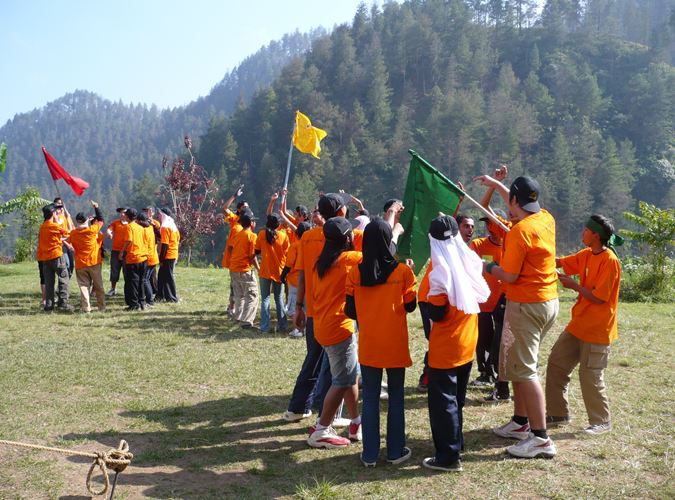
One of the first activities was to divide the students into four groups, with each group composed of students from each of the three ethnic groups. The groups were then asked to come up with a name, a flag and an anthem for their group. The students came up with four teams called Hatta (yellow), Gadjah Mada (red), Patimurra (green) and Hasanudin (blue). Below are some photos of the groups creating flags and rehearsing their group’s anthem.


These four groups then became the basis of the outdoors activities that followed, including Blow Wind Blow activity; the Magic Carpet game, and the Bridge Rescue game.
Blow Wind Blow

Magic Carpet

Bridge Rescue

Each activity or game had specific learning objectives. For example, the Blow Wind Blow activity was designed to encourage students to think about how they perceive themselves and others. For example, do they make judgements on the basis of external, observable features or on the basis of more personal qualities? Students were encouraged to reflect upon which judgements most accurately reflect who they are, and how they feel when other people perceive them on the basis of an external feature.
In general, the activities were designed to encourage team work, cooperation, communication and a sense of solidarity amongst members. Implicit in all was also the need to question and challenge stereotypes and prejudices, along with the situations in which they arise. This theme emerged most explicit in the more introspective and creative activities, such as when students were asked to express their thoughts through poetry, prose and short dramas. On the final day students made a written undertaking to be Agents of Peace and developed a Peace Declaration, which stated that difference is not an obstacle to achieving peace and that unity is based on tolerance and restraint.
Outcomes
So what did the students think of this camp? Did they find it useful as well as fun? On the final morning, students were asked to evaluate the training camp. Their comments were very positive with all students rating the camp’s activities as either very interesting (81 percent) or interesting (19 percent). All students thought the camp was very useful (83 percent) or useful (17 percent) ‘in raising their awareness and skills as a citizen who can play a role in ensuring peaceful relations with other social groups’, and all but two of the students found the games and activities very relevant (70 percent) or relevant (26 percent) to ‘the goal of spreading peace in a culturally diverse society’.
One of the most positive evaluations came from a young woman of Chinese background. We were sitting together on the last evening before dinner when she told me that she hadn’t wanted to come on this camp. She said that she was nominated by her teacher so had no choice in the matter, but that at the time she didn’t want to miss out on two days of school. When we spoke together on the last evening, however, she had changed her mind and said that she was really happy that she had come along. In fact, she would recommend to friends that they come along if they are ever given the opportunity as she had not only enjoyed the camp but learnt a lot.
Only time will tell to what extent this camp has made a difference to students’ behaviour and attitudes. Nevertheless, based on the enthusiasm and commitment of the students, I would say they learnt some valuable social skills during the camp. It is now up to the students themselves to decide how they will use these skills and their positive experience of the camp to work towards peaceful forms of interaction and mutually respectful modes of living together.